
Hamilton County Court Docket Searches
Most people start with the Hamilton County Clerk of Courts Records Search, wait, correct: the Hamilton County Clerk of Courts Records Search, which covers Common Pleas General, Municipal, Domestic Relations, and First District Court of Appeals matters. The menu splits the work into name, case-number, court-date, ticket, attorney, judge, classification, and historical-record searches. It covers Hamilton County only. Ohio has no statewide finder here. Pick the likely division before you search, since one court's record is not another court's docket.
A solid identifier makes everything easier. A case number is the gold standard when you have it. For names, the Clerk suggests a last name plus the first few letters of a first name, then narrowing by division or date only if the list runs long. A name match is just a lead. Open the case summary and case history next to confirm the court, the caption, and the current sequence of docket entries.
- Open the Clerk Records Search and choose the court division most likely to hold the Hamilton County court docket.
- Search by case number, or use the name route with the Clerk's suggested last-name and first-name pattern.
- Open the case summary to confirm the caption, division, and case reference before reading the history.
- Use the case-history order and date controls to isolate recent filings or a particular period.
- Use the schedule route, Clerk counter, or document-request process when a date or filing needs confirmation.
Hamilton County Docket Division Guide
Before any Hamilton County docket search, you have to pick the right court. That choice comes first. The adult portal splits jurisdiction by division. Common Pleas, General Division takes adult felonies plus civil cases above $15,000. Municipal Court handles misdemeanors, traffic, and civil matters under $15,000. Domestic Relations is there too. So is the First District. Probate and Juvenile take separate routes entirely. The Hamilton County Courts overview lays out this split. It helps when paperwork names a court but not a way to search it. A fresh division or an unfamiliar number on a case can point to a related proceeding, maybe an appeal or a mayor's-court transfer into Municipal Court. Treat it as a clue, not a duplicate. Hamilton County Courts publishes its court hierarchy and campus information.
That hierarchy is the reason the court named on your citation, filing, or order matters. Knowing the division tells you where the Hamilton County docket you need actually lives before you start searching.
Court Dockets: What They Show
Hamilton County uses several labels that overlap. The case summary is the top-level view. The case history, also called the register of actions, lists every filing and court event in order. Pull up a docket and you may see the case number, division, caption, party roles, assigned judge, filing dates, entries, settings, orders, and disposition information. It is a public reference record. It is not a certified copy.
Every date carries its own job. A filing date marks when the clerk accepted or journalized a document. A notice of hearing or setting points to a scheduled event. A later entry can still move it. A disposition tells you how a charge or claim ended. The order or judgment is the formal action behind it. Images and financial details vary by case. They can stay restricted even when the case history is open.
| Case number | Routes the search to a division; local request-form families include A, B, C, DR, and CV. |
|---|---|
| Case summary | The portal's case-level overview and entry point to the history. |
| Case history | The time-ordered register of filings and court entries, which can be sorted or narrowed by date. |
| Setting | A scheduled appearance that needs confirmation through the current schedule or the identified court. |
| Order or judgment | A court action; remote availability can differ from the docket entry that identifies it. |
Hamilton County Docket Labels
Local labels make useful search tools. Across Hamilton County systems, "docket," "register of actions," and "case history" all describe the same running sequence of events. "Case summary" names the case before you open that sequence. The Clerk's case-history route also lets you sort ascending or descending. It offers optional begin and end dates too. That helps when you need to pull an older filing apart from a later setting.
Case prefixes add another clue. The Clerk's document-request form ties A to Common Pleas Civil. It also ties B to Common Pleas Criminal, C to appeals, DR to divorce, and CV to Municipal Civil. Municipal criminal and traffic families include CRA, CRB, TRD, and TRC. A prefix steers the docket search toward the right court records. The case record itself confirms what the prefix means.
- Arraignment
- An early criminal appearance. The Clerk posts an adult felony arraignment docket one business day before appearance, subject to change.
- Continuance
- A setting moved to another date. The latest schedule, not the first notice, is the safer current reference.
- Disposition
- The way a claim or charge ended. The entry may identify it, while the court order provides the formal detail.
Hamilton County Courts and Their Dockets
One search does not cover every Hamilton County court record. The Clerk runs a consolidated public search. It spans Common Pleas General, Municipal, Domestic Relations, and First District appeals, and those divisions sit inside the Clerk's operational structure. Probate stands apart. Its own record search offers an index, case detail, docket entries, and PDF images where available. Juvenile is separately administered too. It handles records through a dedicated channel rather than the general adult case browser.
City cases add another wrinkle. Cincinnati traffic and misdemeanor matters usually flow through Hamilton County Municipal Court. Forest Park, Norwood, Sharonville, and Blue Ash each run a Mayor's Court for local violations. A city case can later be transferred, certified, or appealed. The county docket or the receiving court's docket then becomes the record that matters.
| Court or channel | Typical docket matters | Public starting route |
|---|---|---|
| Court of Common Pleas, General Division | Adult felony and higher-value civil matters | Clerk Records Search, then the Common Pleas division |
| Hamilton County Municipal Court | Misdemeanor, traffic, and lower-value civil matters | Clerk Records Search, then Municipal Criminal/Traffic or Municipal Civil |
| Probate Court | Estates, guardianships, marriage licenses, and mental-health matters | Probate Court Records Search |
| Juvenile Court | Child-related delinquency, dependency, custody, and support matters | Juvenile public-records request channel |
Hamilton County Docket Systems
Ohio has no statewide public search for trial-court cases. The Ohio Supreme Court's eStats service reports numbers, not individual dockets. For Hamilton County adult matters, start with the County Clerk's Records Search. It is the main portal for a docket search. Federal cases sit somewhere else entirely. The Southern District of Ohio uses PACER. Those filings never appear in the Hamilton County Clerk's docket system.
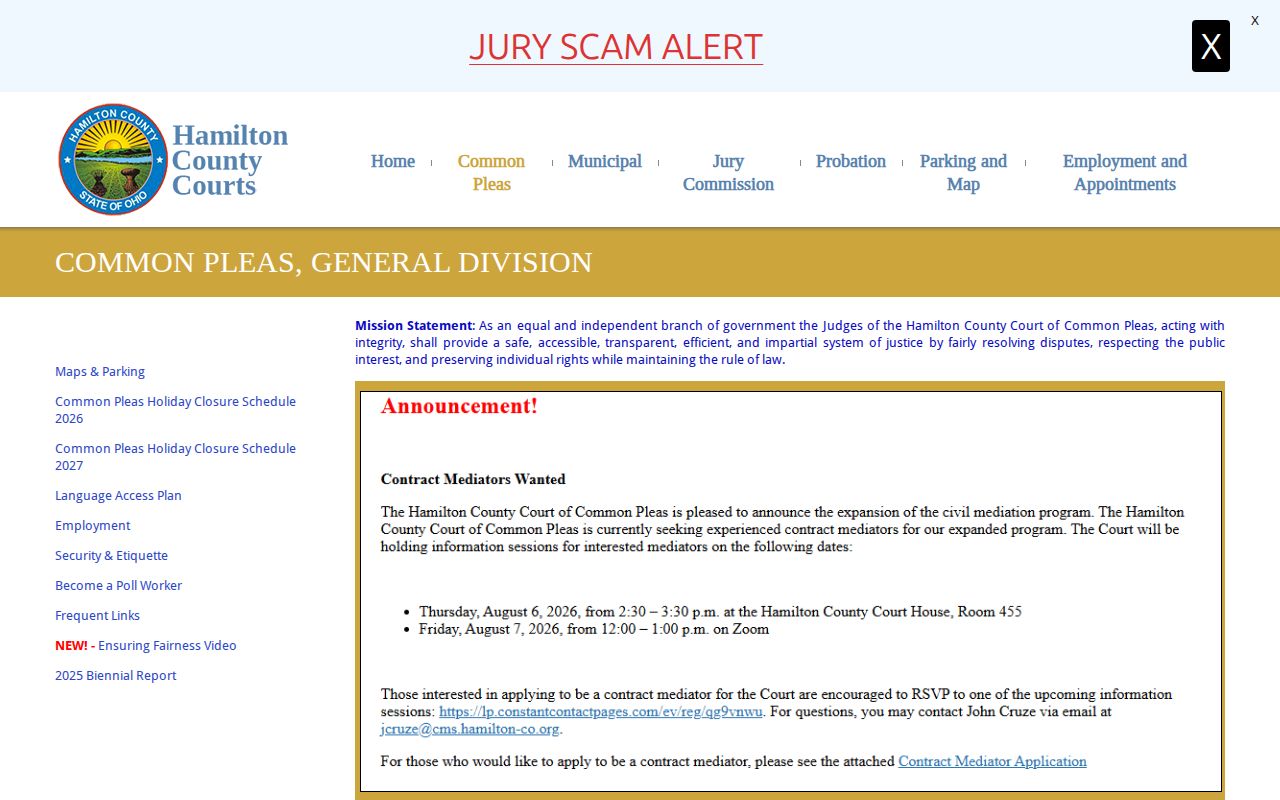
The Common Pleas General Division page marks the county's principal trial-court channel for felony prosecutions and higher-value civil cases.
Stick with the county court and Clerk channels for state cases. Turn to PACER only if the case actually sits in the federal system. The U.S. District Court for the Southern District of Ohio explains its Cincinnati federal court access routes.
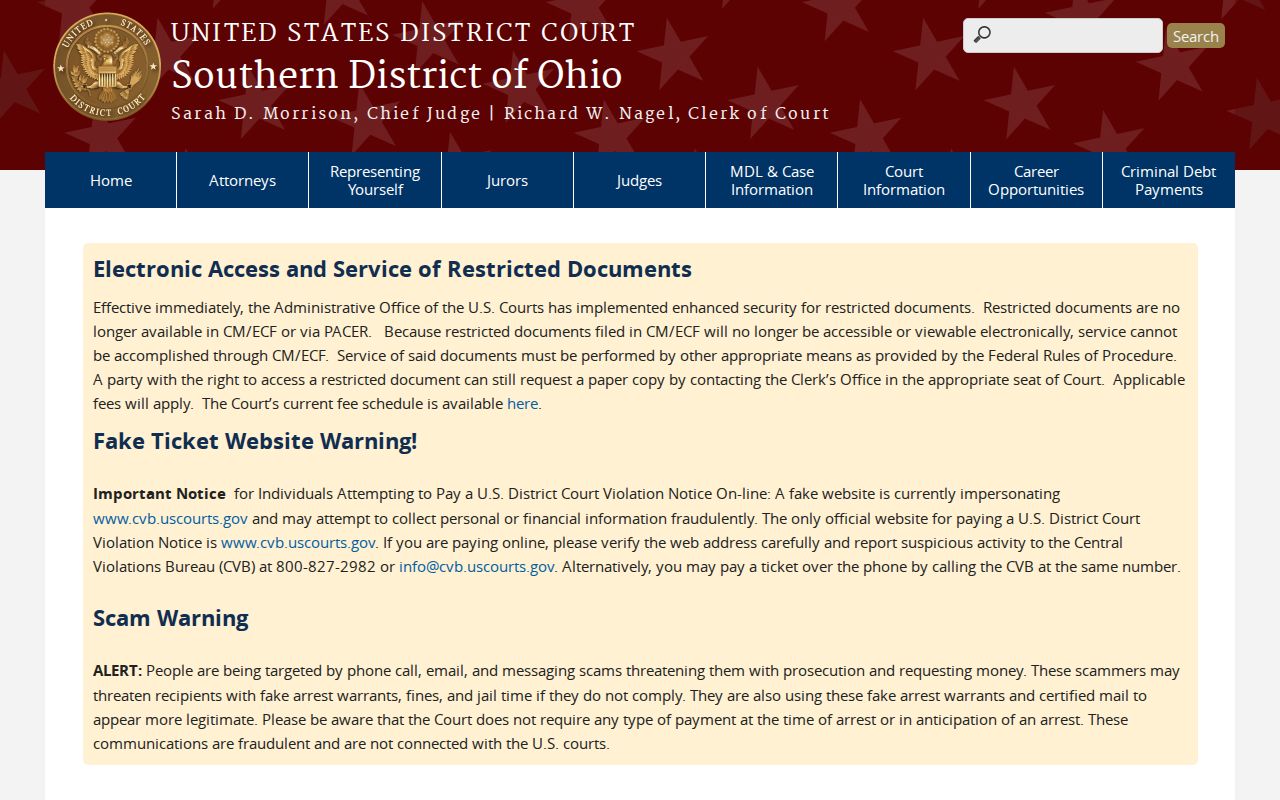
A federal docket may be open to the public, but registration, fees, and document-access rules all follow the federal court's own terms.
Court Dates and Settings in Hamilton County
There are several ways to pin down a Hamilton County court date. The Clerk's Court Date menu offers several routes. Search by case number, attorney, or public parties. You can also search by court and judge. It also offers schedule views by attorney and by date and court. Got the case number? Start with the schedule-by-case route. If you only have a name, run the name search first. Learn the number, then check the schedule.
Paperwork still matters. A citation, subpoena, prior order, or notice usually names the court and the date. But an older docket line can go stale after a continuance. Do paperwork and an online entry disagree? Is the online entry incomplete? Confirm with the court's schedule, the assigned courtroom, or the Assignment Commissioner. The county Court Schedule lists the search path for each division.
Hamilton County Court-Date Safety Net
Online schedules are not the only option. The Court Hearing Information route adds physical and telephone fallbacks. Free touch-screen Kiosk Computer Help Stations stand near the Courthouse entrance elevators. Others sit outside Room 255. They display the next seven days of Municipal and Common Pleas criminal and civil schedules. They work well without a portal login. Use them for a short-range schedule, or when a web search just is not available.
Need a verified criminal case? The hearing page points to the Municipal Assignment Commissioner, the Assignment Commission offices, and the Clerk's 24-hour line. Civil settings run through their own Clerk and assignment channels. One caution: the official pages list two different Municipal Assignment phone numbers. Have the case number ready, and confirm the current number with the office. A phone call alone will not change or continue a setting.
The Hamilton County Municipal Court page identifies the local Municipal court channel.
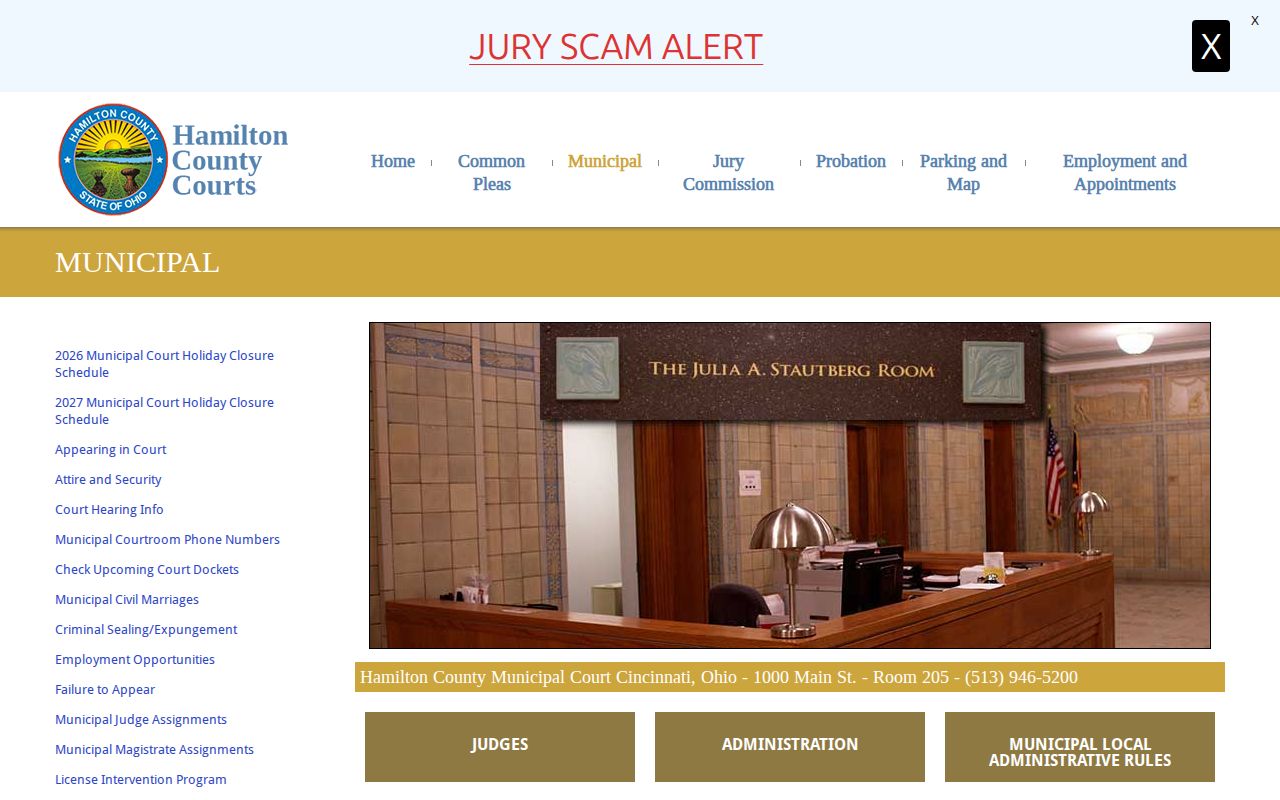
Search and confirm Municipal criminal, traffic, and lower-value civil records through the appropriate Municipal division.
Docket Access Under Ohio Law
Ohio treats court records as presumptively open, yet access runs through specific channels. Ohio Rules of Superintendence Rule 45 sets a baseline. Courts and clerks must provide direct access and reasonable copying. Rule 45(C) does not require remote access to every record. Closer to home, Hamilton County Municipal Local Rule 9.16 describes what is available remotely: indexes, dockets, calendars, eligible orders, liens, and images. The same rule flags material that stays restricted or court-facility only.
The public-record framework comes from Ohio's Public Records Act, R.C. 149.43. That law underlies the Clerk's request policy. It does not erase case-specific restrictions. Sealed records, sensitive identifiers, juvenile material, and medical information may be missing from an online docket or document view. Local rules name still more categories. A missing image never proves the case is absent. The filing or the case can still exist.
Key access rules: Ohio Sup.R. 45 presumes access to court records and distinguishes direct access from remote access. R.C. 149.43 is the Ohio Public Records Act and sets the public-records framework. Hamilton County Municipal Rule 9.16 addresses local privacy and remote-access categories. R.C. 2953.32 governs parts of the criminal sealing process, while R.C. 2151.356 addresses juvenile sealing.
Hamilton County Docket Access Rules
Seeing a docket remotely is not the same as seeing every document in it. Hamilton County's local privacy rule allows remote calendars, dockets, judgments, liens, and eligible images. Some filings, though, stay inside a court facility or face other restrictions. Trial exhibits and transcripts need different handling. So do grand-jury and jury material, certain warrants, sensitive information, and sealed records. A case history can stay useful. That holds true even when an image is missing from the case view.
Does a missing document matter? Write down the case number, the entry date, and the document description. Add the page count if the portal shows it. Then go through the Clerk's request route. A counter visit works too. A clear request helps the Clerk find the record and explain any redaction or denial. Certified copies come from the custodian, never from a public case-history display.
How the Clerk Keeps Docket Records
The Hamilton County Clerk of Courts keeps the official docket for the adult justice system. The office receives and journalizes filings. Those cover Municipal Court, Common Pleas General Division, Domestic Relations, and the First District Court of Appeals. That shared role does not merge everything, though. Probate and Juvenile keep their own separate court-operated records channels. Any adult-court search should still include the Clerk's division selector.
Once a docket entry points to a document, you need a copy request. The Clerk's Request Record page is the bridge. Its direct Document Request Form asks for key details. Bring the case number, caption, document type, date filed or entered, and other identifying details. Pickup, mail, or email all work where allowed. Archive, microfilm, or redaction work can take longer, and no fixed turnaround is promised.
Hamilton County Clerk of Courts
Common Pleas Civil and Criminal, Room 315
1000 Main Street, Cincinnati, OH 45202
513-946-5699
Hamilton County Clerk Record Requests
Let the docket locate the case, then request the exact record. Ordinary public-records requests need no special words. No stated purpose is needed either, the Clerk says. They do need enough detail to locate and review the item. The online request page notes that redactions are marked. A denied or redacted request should come with an explanation and legal authority. Prepayment may be required for copying or mailing.
Fees depend on the record and the division. The general request policy lists plain copies at $0.10 per page and general certified copies at $1 per page. The Municipal Criminal fee page lists $5 for a certified copy, and the Municipal Civil schedule lists $1 per page. Check the division schedule before you pay. Historical records may start with a digitized index and then need a docket-book reference or a clerk request.
| Request type | Published local guidance |
|---|---|
| Plain public-record copy | $0.10 per page under the Clerk policy |
| General certified copy | $1.00 per page; the policy says it is not electronic |
| Municipal Criminal certified copy | $5.00 under the current Municipal Criminal fee page |
| Municipal Civil certified copy | $1.00 per page under the Municipal Civil fee schedule |
Hamilton County Docket History
Digging into older Hamilton County court records? Start with the Clerk's historical collection rather than the modern case portal. The digitized indexes cover Common Pleas from 1802 to 1884 and District Court from 1851 to 1884. They also cover Superior Court of Cincinnati from 1854 to 1884, Circuit Court from 1884 to 1912, and Insolvency and Divorce Court records. An index entry can hand you a reference number. Use it for a later request to the clerk or an archive.
The county's paper history explains the gaps in the docket record. The Hamilton County Law Library counts six courthouses over the years, and several were lost to fire. The current courthouse dates to 1919. Each tool serves a different purpose. It might be a historic index, a reconstructed book, a microfilm request, or a modern docket search. None of them is a complete online set of original documents.
For state appeals, the First District Court of Appeals of Ohio is the Hamilton-only channel.
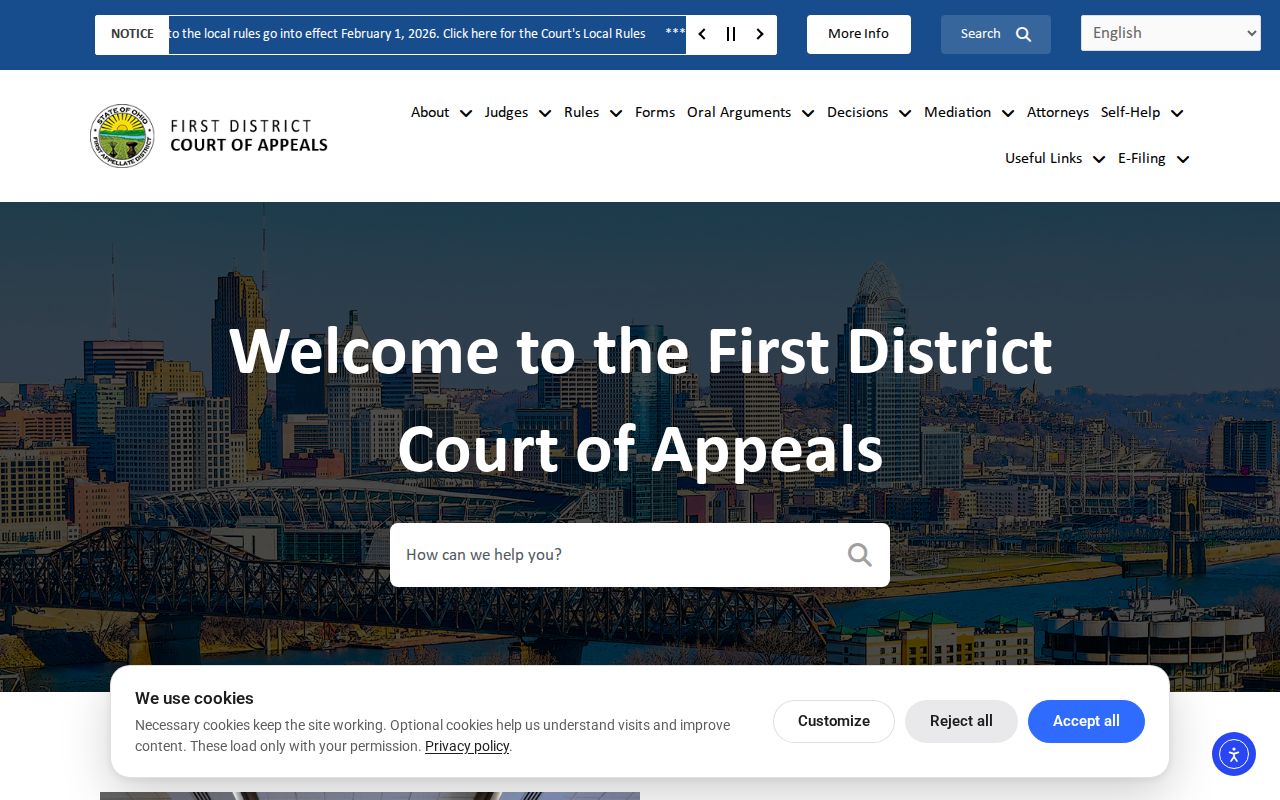
One caution on appeals: an appeal opens its own separate appellate docket. A related Common Pleas or Municipal case is not the same record, so don't confuse the two when reading a docket. Hamilton County Juvenile Court posts its own court-services and location channel.
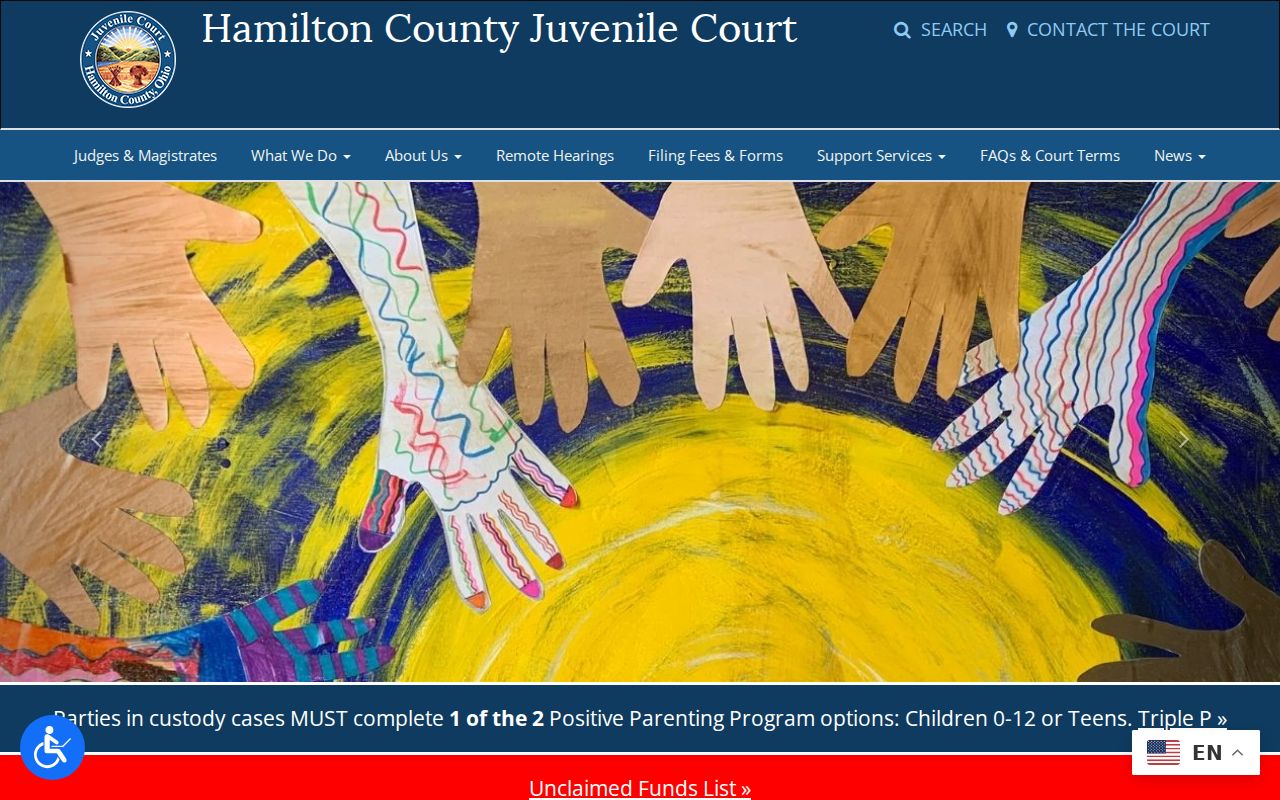
Juvenile cases run through their own system. Records there come from the Juvenile Court's process, not the general adult portal. For the federal appellate route, the Sixth Circuit is separate from Hamilton County's First District.
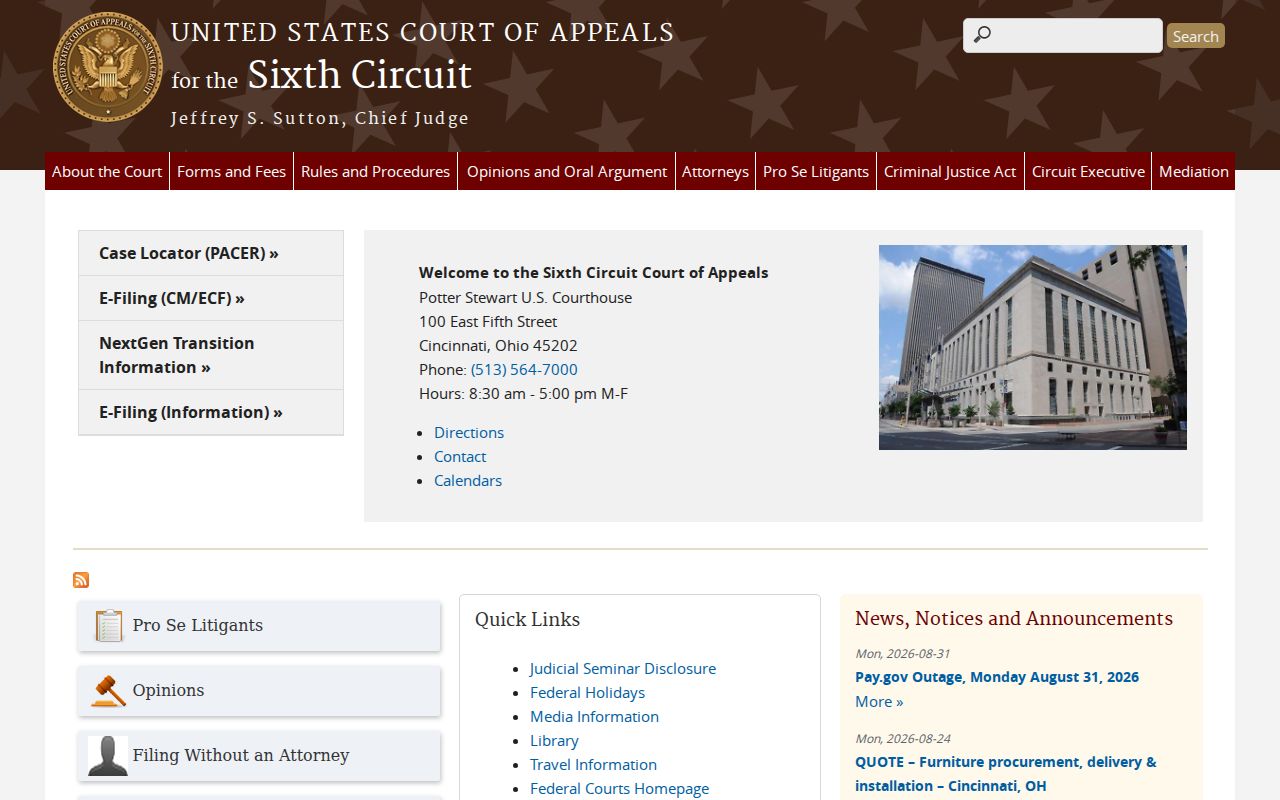
State appellate records and federal appellate records use different courts and different public-access systems.
City-by-City Court Dockets in Hamilton County
Cincinnati is the county seat. Adult traffic and misdemeanor cases land in Hamilton County Municipal Court, though. There is no separate Cincinnati Mayor's Court docket for that work. Forest Park, Norwood, Sharonville, and Blue Ash each run Mayor's Courts for local matters. The citation itself names your starting court. A city case belongs in the County Clerk docket search only after a verified transfer, certification, or appeal. That step is what moves it into county hands.
The five largest incorporated cities by 2020 Census population appear below. Sharonville straddles county lines, which makes the citation-first check matter even more there. Also note one more split. Cincinnati parking violations go through the City Parking Violations Bureau. They do not go through the Hamilton County Municipal Criminal/Traffic docket.
Cincinnati Court Records
Population 309,317. County Municipal Court route, with a separate city parking process.
Forest Park Court Records
Population 20,189. Local Mayor's Court portal and city Clerk channel.
Norwood Court Records
Population 19,043. Mayor's Court record route before a verified county transfer.
Sharonville Court Records
Population 14,117. Mayor's Court process with a possible county or Butler County destination.
Blue Ash Court Records
Population 13,394. City Mayor's Court search before any documented Municipal transfer.
Map and Directions to the Hamilton County Courthouse
Common Pleas Civil and Criminal records are kept at the Hamilton County Courthouse, 1000 Main Street, in downtown Cincinnati, at the Clerk's Room 315 counter. Municipal Civil is a separate Room 115 counter in the same building, while Municipal Criminal/Traffic is filed at the Justice Center, 1000 Sycamore Street, just behind the Courthouse. Every entrant passes through the Sheriff's Security Checkpoint, and the Courthouse opens at 8:00 a.m., with the court's own page warning that 8:30-9:30 a.m. brings the longest lines.
Hamilton County Clerk of Courts
Common Pleas Civil and Criminal, Room 315
1000 Main Street, Cincinnati, OH 45202
513-946-5699
Monday through Friday, 8 a.m. to 4 p.m.
Hamilton County Justice Center (Municipal Criminal/Traffic)
1000 Sycamore Street
Cincinnati, OH 45202
513-946-6010
Monday through Friday, 8 a.m. to 8 p.m.; bond services available 24 hours
Free touch-screen kiosks near the Courthouse entrance elevators and outside Room 255 show Municipal and Common Pleas criminal/civil schedules for the next seven days without a login. The Clerk confirms public and paid downtown parking exists but does not publish a price table, so plan extra time near the security checkpoint before an early-morning appearance.